

Public speaking is not my forte. In fact, I’ve gotten so nervous while public speaking that I have very nearly fainted on multiple occasions. But this will not do as a communications professional.
So when a fellow master naturalist trainee told me she took an improv class as part of her environmental communications master’s program, I was intrigued. She explained to me that improv taught her to always elevate her scene partner, which in her job educating the public on tick-borne illnesses meant her audience and community members. Wondering if improv could lessen the frequency of my fainting spells, I signed up for an eight-week course in improv fundamentals.
My tick-risk communicator friend was right. Improv is making me a better communications professional.
Here’s what I’ve learned so far.
Yes, and. The core principle of improv is to never say no to your scene partner but instead build on whatever they offer. It is collaboration in its purest form — you are fully reliant on each other for success, and your scene moving forward depends on you working together, listening well, and moving forward in sync. What could be a better analogy for environmental campaign development? In order to succeed, we need to all move forward together, and to do so we need community members, elected officials, scientists, policy experts, and operational leaders, all of whom hold a different piece of the story, to listen, collaborate, and move forward together.
Your partner’s world becomes your world, even when you don’t understand it. In improv, whatever your scene partner establishes becomes the reality you work within. If they say you are in a creamery, you’d better get to churning. If they declare the bus is moving, then buckle up, my friend.
Environmental communicators know this scenario well. You arrive ready to discuss the environmental impacts of a proposed plastic reduction policy, and someone in the room says we should just recycle more. The instinct is to steer back to your talking points. Improv teaches the opposite: meet people inside the conversation they want to have. If they want to talk about recycling, talk about recycling, but allow the detour to become a bridge. Once you’ve acknowledged their frame, you can show where points fit within a larger system and carry them toward the issue you came to discuss.
Be present, listen, and follow the path that opens. Success on the improv stage depends on setting aside what you planned and responding to what is actually happening. You can’t direct or self-edit your way through a scene; you have to stay agile and think on your feet. That discipline translates directly to public speaking, presentations, and press events, where the room rarely follows the script.
Always thank your audience for their suggestions. Nearly every improv format begins by asking the audience for a prompt, whether it’s an improvised musical, a movie, or an Armando, a long-form improv set inspired by a personal monologue. Asking the audience for the lead reminds me of running a public outreach meeting or press event, where the contributions from the crowd are often not what you expected. Questions or feedback may be offbeat or obscure, and likely deeply personal to the person offering them (but perhaps not mean anything to you). In both settings, the skill is the same: receive the suggestion graciously, honor what it means to the person who offered it, and shape it into something relevant. In improv, it should also be funny. Maybe environmental communications needs more humor as well.
Failure is part of the work. Improvisation means failing often and in public, and doing it with a smile. The same is true of environmental communications. Sometimes no one picks up your press release. Sometimes the media misrepresents the issue. Sometimes an interviewee goes off-script. We do the work and hope it lands, sometimes more so than other times. And then we brush ourselves off and try again.
Yes, and… let’s talk.
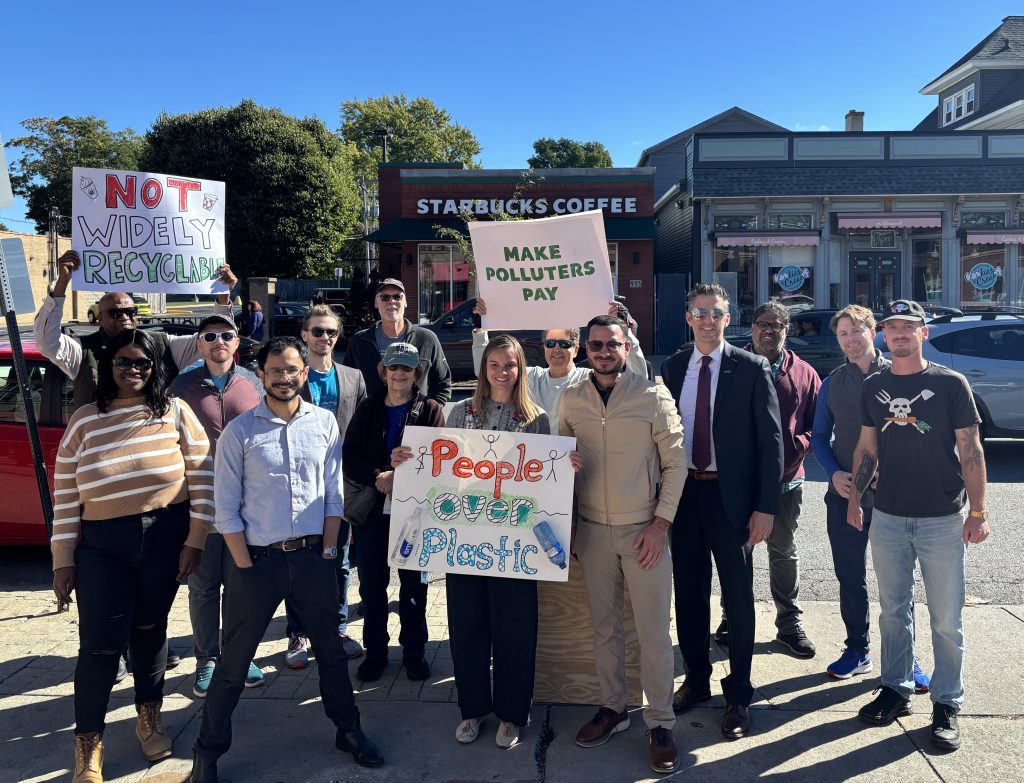
This past weekend, I led a demonstration and press event for Beyond Plastics Buffalo, a local group with whom I volunteer. The media showed up late, it was exceptionally sunny, and my colleague’s remarks didn’t follow what I had outline. But rather than let my nerves take over or my must-control-everything-attitude reign, I just kept telling myself, “This is all improv, this is all improv.” I stayed relaxed, led a successful press event, and everything went well. We got good media coverage, strengthened community bonds, and our speakers made some excellent points. It really is all improv, whether we can admit it or not.
If you want to build a scene together — or rather, a campaign — get in touch. I’d love to help elevate your message.


Leave a comment